Ohio Just Required Every District to Have an AI Policy. Here's What Actually Ended Up In One.
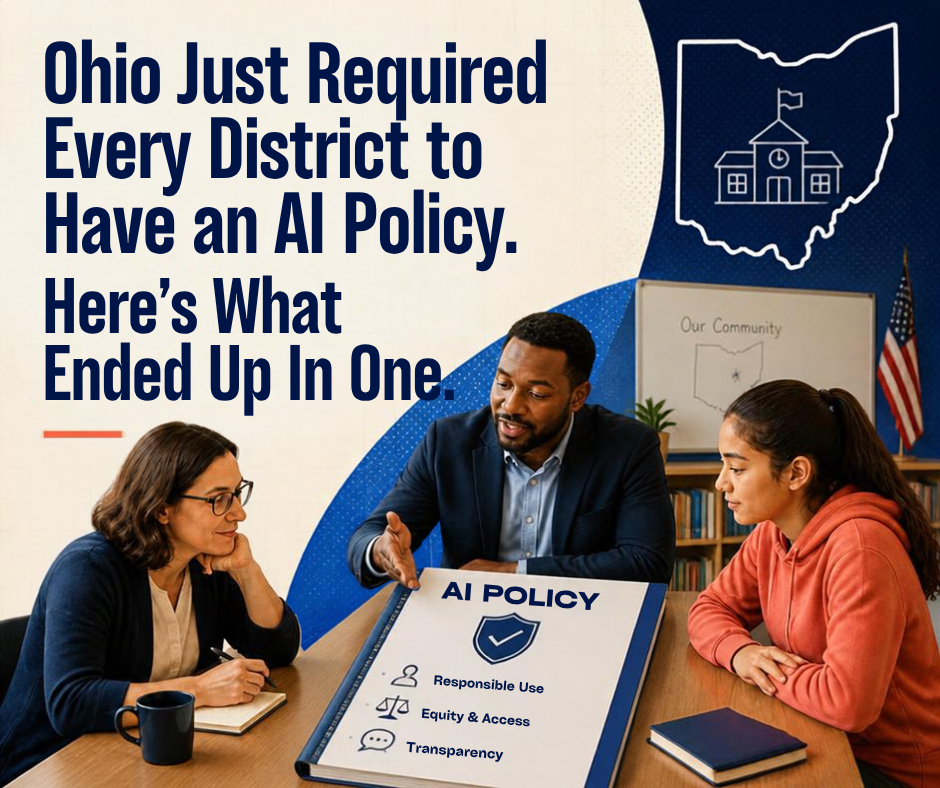
Ohio required every K-12 district to adopt an AI policy by July 2026. Here's what the state's model policy and early district policies actually cover.
Ohio is the first state to make an AI policy mandatory, not optional, for every public school district. Under House Bill 96, every traditional public school district, community school, and STEM school in the state had to adopt a formal, board-approved AI policy by July 1, 2026. The deadline has already passed, which means Ohio now has hundreds of real, adopted policies to look at.
Most districts elsewhere in the country are still in the "recommended guidance" phase, where a policy is encouraged, but nothing requires it to exist by a specific date. However, the Ohio Department of Education and Workforce was required to publish a model policy by the end of 2025, and every district had six months after that to adopt it as written or adapt it to their own needs. Whether or not your state has done anything like this, the categories Ohio landed on are worth taking note of, because they're likely close to what your own district will eventually land on, too.
The state's model policy, developed with Ohio's AI in Education Coalition, covers a specific set of areas: appropriate use of AI by students and staff, data privacy and protection of personally identifiable information, ethical use guidelines, considerations specific to teacher use versus student use, a process for evaluating AI tools from third-party vendors, and the impact of AI use on learning objectives and student assessment. As the template, districts were free to adopt it as-is, or customize it.
Columbus City Schools, the state's largest district, gives a useful look at what customizing it actually produced. Their board unanimously adopted a policy ahead of the deadline that gives teachers discretion over whether AI is allowed on any given assignment, treats unauthorized AI use as a form of plagiarism, restricts staff to an approved list of AI applications rather than anything on the open market, and explicitly bars student and staff data from being used to train AI models. None of that came from the state template directly. Columbus's board decided what each category should say once real language had to go on paper.
A few pieces of this matter most if you're trying to get ahead of a policy in your own building.
The data provision matters more than it looks like at first. "Don't let AI train on student data" sounds like a legal or IT concern, not a classroom one, but it's the kind of clause that shows up because someone asked a hard question about a specific tool: does this app keep what students type into it, and what happens to that data afterward. Ask that question about any AI tool before it's in front of your students. No policy has to require it first.
The vendor evaluation piece is the one most classroom-level conversations about AI policy skip entirely. Teachers tend to think about policy in terms of what students are allowed to do. Districts, once they're forced to write something down, end up spending more time on what teachers are allowed to do than students. Most schools without a policy yet are missing the approved list, not the student rules.
Columbus's "teacher discretion" model sounds like a loophole, but it's the harder policy to live under. A rule that says "no AI, ever" is easier to enforce and easy to explain to a parent. A rule that says "it depends on the assignment, and the teacher decides" puts the judgment call back on you, every time, with no script to fall back on. It's more flexible. It's also more exposed if you haven't thought through your own answer in advance.
If your school hasn't been asked to write anything yet, no one's been assigned to write it, not that no policy is coming. Ohio didn't get hundreds of policies because every district wanted one, it got them because a law set a date. Most places are still waiting on that date, or on someone above them to hand down direction. Work out your own answers to those same categories now, allowed uses, data handling, teacher versus student rules, and you won't be writing one from scratch under pressure when the request finally comes.
If you want to work through those same categories for your own classroom, the AI Classroom Policy Starter Checklist walks through allowed uses, citation expectations, consequences, and a review date, the same ground Ohio's policies end up covering, sized for one teacher instead of an entire district.
Join the Email List
No fluff, no spam. Just strategies, resources, and updates worth opening.