Teaching Students to Check the AI's Work
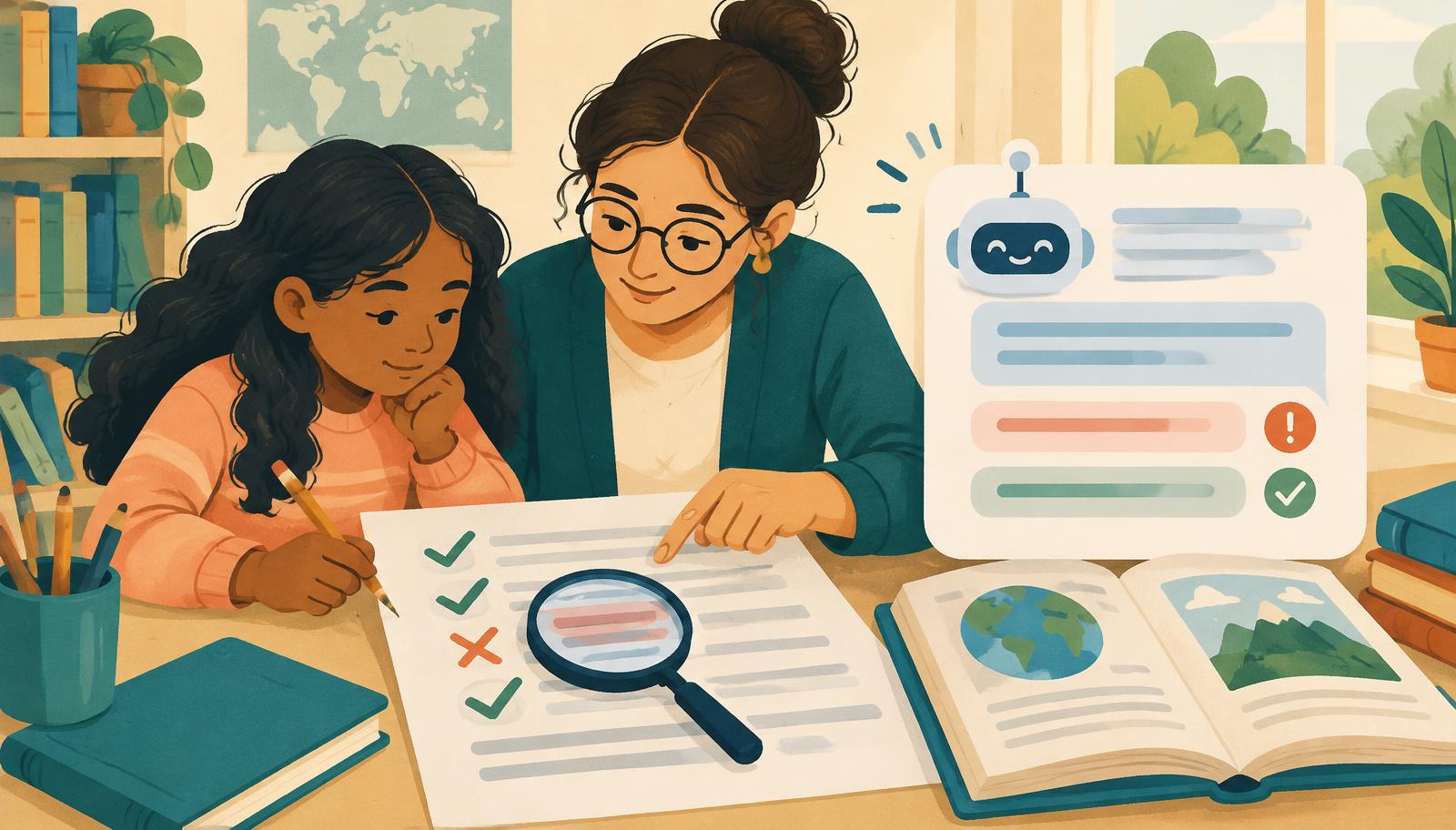
Students will use AI whether or not we plan for it. The skill worth teaching is verification: how to slow down, compare, and catch what a confident answer gets wrong.
Most conversations about students and AI start with a question about cheating. That question matters, but it is not the only one. A more useful question for classroom teachers is this: when a student reads an AI answer, do they know how to check it?
AI tools write fluently. They sound sure of themselves. And they are sometimes wrong in ways that are hard to spot: a made-up source, a step skipped in a math problem, a sentence that contradicts the text it claims to summarize. Students who treat fluent writing as correct writing are the ones most likely to be misled.
Verification is a teachable skill
Checking an answer is not a personality trait. It is a set of habits, and habits can be modeled, practiced, and assessed. The good news is that teachers already teach most of them. Close reading, citing evidence, showing your work, and comparing sources are all verification moves. AI simply gives students a new, very convincing text to practice on.
A simple routine works across grade levels:
- Read the claim. What exactly is the AI saying?
- Find the source. Where would we check this: the textbook, the article, the problem itself?
- Compare. Does the answer match the source, contradict it, or add something the source never said?
- Decide and fix. Keep it, correct it, or throw it out, and explain why.
Four mistakes worth naming
Students catch errors more reliably when they have names for them. Four categories cover most of what younger and older students will meet:
- Wrong facts. The answer states something that is simply not true.
- Contradictions. The answer disagrees with the source it is supposed to be based on.
- Made-up sources. The answer cites a page, quote, or line that does not exist.
- Hard to read. The answer is technically correct but too complicated for the reader it was written for.
Naming the mistake turns "this feels off" into "this contradicts paragraph two," which is exactly the kind of evidence-based thinking we want in every subject.
Start small and low stakes
Students do not need a device to practice. Print a short AI-style response next to a few true facts and ask students to mark what holds up. In math, give them a worked solution with one error and ask them to find the step where it breaks. In ELA, hand them an AI summary and the original passage. The source stays the authority, and students learn that the answer has to earn their trust.
A few tips keep these activities productive:
- Keep the source short enough that every student can check it.
- Include at least one answer that is fully correct, so students do not assume everything is a trap.
- Ask for the fix, not just the flag. Correcting the error shows understanding.
- Talk through disagreements as a class. Two students who caught different problems are both doing the work.
Why this matters now
Students are already encountering AI writing in search results, apps, and homework help tools. Banning a tool does not teach students what to do when they meet it anyway. Teaching them to check, compare, and correct gives them a skill that transfers well beyond any single tool, and it reinforces the evidence habits we value in every class.
Resources to try
If you want ready-made practice, the free AI Debug Lab lets students in grades 3 through 12 catch AI mistakes in short, game-style cases with no login. For classroom-ready lessons, warm-ups, and math error-analysis packs, browse Classroom Materials, and find more free tools on the Free Resources page.
Join the Email List
No fluff, no spam. Just strategies, resources, and updates worth opening.