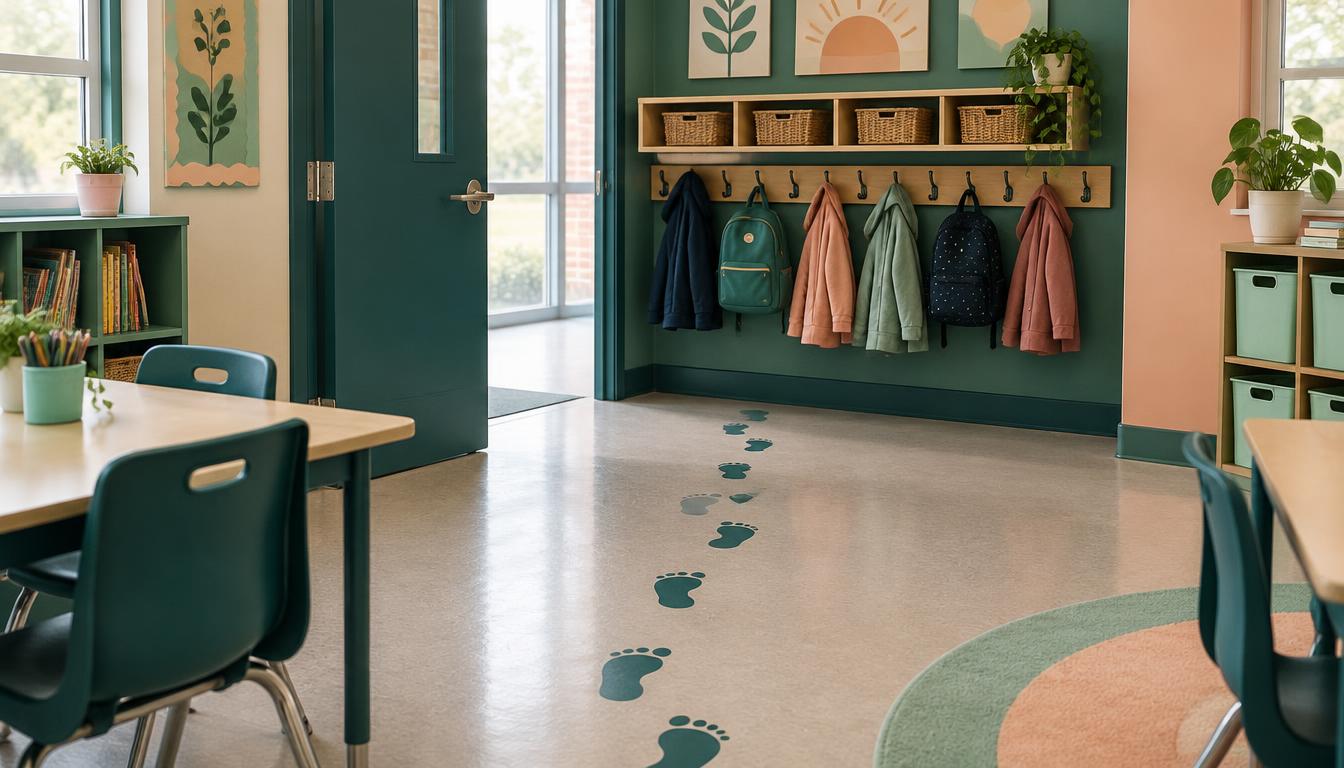
Not every moment in a classroom day is worth the same amount of planning. A teacher with limited time and energy doesn't need thirty different routines. Five recurring moments account for most of the ambiguity tax described in Lesson 2.1, and building strong routines around just these five closes most of the gap.
The five moments
Where Routines Pay Off Most
Each moment below includes what it looks like, the words to use, and the mistake to avoid.
The first sixty seconds
Entry
What it looks like
What happens in the first sixty seconds after a student walks through the door sets the tone for everything after it. A strong entry routine answers, without a teacher saying anything, what a student does with their body, their materials, and their attention the moment they arrive.
In practice: the teacher stands at the door and greets each student by name. The same spot on the board always shows a short task, like a warm-up question or a sketch prompt. Students hang their bags, take their folder from the bin, and start the task within a minute. The teacher circulates instead of calling for attention.
Say it like this
"Good morning. Folder, seat, board. You'll have three minutes on the warm-up, and I'll be around to see your thinking."
Common pitfall
Starting with attendance or announcements while students wait. Every minute without a task becomes a minute students fill on their own, and a loud, scattered start usually begins here.
The biggest source of lost time
Transitions Between Activities
What it looks like
This is the moment Mr. Bennett's colleague was watching in Lesson 2.1. A transition without a clear signal and a clear next step is the single biggest source of ambiguity tax in most classrooms, because it happens multiple times a day, every day.
In practice: one consistent signal (a chime, a raised hand, a countdown), then the next step stated in one sentence before anyone moves. Students know where to go, what to bring, and how long they have. The teacher times it and names the result.
Say it like this
"In a moment, not yet: notebooks closed, move to your reading groups, and have your book open by the time I count to twenty. Go."
Common pitfall
Giving directions while students are already moving. Half the room hears the instructions, half doesn't, and the teacher repeats them three times.
Instructional minutes hiding in plain sight
Materials Distribution and Cleanup
What it looks like
Handing out and collecting materials eats real instructional minutes when it's improvised. Every minute spent on chaotic distribution is a minute not spent on the lesson, and it's one of the easiest of the five to fix permanently once it's taught well.
In practice: materials live in labeled table bins or one supply station. One assigned student per table collects and returns them. Papers pass in one direction, and cleanup begins on a set signal with two minutes on the clock.
Say it like this
"Supply captains, bins to your table. Everyone else, hands free until the bin lands. At cleanup, captains return the bin with every marker capped."
Common pitfall
The teacher handing materials to every student personally. It feels helpful, but it leaves 25 students waiting and no one practicing responsibility for the room.
Protecting the quiet strugglers
Asking for Help
What it looks like
Without a clear routine, asking for help usually means calling out, or worse, quietly not asking at all and staying stuck. A strong routine protects both instructional flow and the kids who are least likely to raise a hand on their own.
In practice: students follow a clear sequence (try it yourself, check your notes, ask a partner, then signal the teacher) and use a silent signal, such as a help card on the desk. While they wait, they move to a designated next problem so stuck time doesn't become lost time.
Say it like this
"If you're stuck, flip your card to the yellow side and skip to the next problem. I'll come to you. You never have to wait with nothing to do."
Common pitfall
Responding only to the students who call out. The loudest students get the most help, and the ones who are silently stuck fall further behind.
Ending on purpose
Dismissal and Exit
What it looks like
The last few minutes of a class period or day often get the least planning of all, right when everyone's energy and patience are lowest. A clear routine here prevents the day from ending on the scattered, reactive note this whole module works against.
In practice: the teacher stops instruction three to five minutes early. Students complete a short exit ticket, clean their space, and wait seated until the teacher, not the bell, dismisses them, often by table once each space is ready.
Say it like this
"Exit ticket on the corner of your desk, chair pushed in, then eyes up. Tables that are ready go first. See you tomorrow."
Common pitfall
Teaching until the bell rings. Students start packing on their own, the closing point of the lesson gets lost, and the room empties in a rush.
Apply it
Where to Start by Band
Start with: Entry and transitions. Young students have the least internal capacity to self-manage an undefined moment.
Make it physical: Footprint decals at the door, a picture schedule on the board, and color-coded table bins give students something concrete to follow without reading directions.
Make it musical: Use a call-and-response ("Class, class!" / "Yes, yes!") or a short transition song that lasts exactly as long as the transition should.
Practice it like a skill: Rehearse each routine three times on day one, then again after every long weekend. Praise the specific behavior: "You put your folder in the bin without being asked."
Five moments, taught well, close most of the gap. You don't need thirty routines. You need the right five.
First, take 30 seconds: Of the five moments above, identify the one costing your room the most time and energy right now.
Then, before you continue: Notice whether you've ever actually taught that moment explicitly, using Lesson 2.2's four steps, or just expected it to run itself.