Where Are You Getting Your AI PD This Year?

State AI policies are moving fast. Here is what will actually count toward your teacher relicensure hours, how to get reimbursed, and how to get outside PD approved.
Every year, it is the same routine. You open the PD tracking spreadsheet you have kept since your first license. Twenty hours by June. Or fifteen. Or whatever your state or district requires. You have some hours banked from a conference and a few from district in-service days. You still need to fill the rest.
Then you look at last week's staff email. Something about the district's new AI policy. Something about teachers being expected to know how to use these tools responsibly and effectively in the classroom this year. No specifics yet. No deadline you can plan around. Just enough language to make you wonder if there is a shoe about to drop.
If that is where you are sitting right now, you are not alone. A May 2026 Gallup survey found that 82% of teachers have not received formal guidance on AI use in their jobs. That number is going to move fast. And it is going to move in a direction that costs you time if you wait.
Here is what is actually happening, what will and will not count for your relicensure, whether you can get any of it paid for, and how to get ahead of it before your district scrambles.
What is actually happening in your state
At the state level, AI in education is moving quickly. A growing number of states have enacted laws requiring districts to adopt formal AI policies, each on its own compliance timeline. Some of those deadlines have already passed. Others land in the next school year or two.
That is the enacted list. Broader than that, 33+ states have now published some form of AI education guidance for K-12 schools, and dozens more have bills in draft or committee. FutureEd, MultiState, and Working Educators all track this movement, and it is accelerating month over month.
Some of these laws go further than policy adoption. A few states now require the state itself to offer AI professional development to teachers and school leaders, or require each district to designate an AI coordinator. Others have directed their education agencies to publish teacher training guidance, or have funded teacher training grants outright.
At the federal level, the US Department of Education has issued Dear Colleague Letter guidance encouraging schools to use federal grant funds to explore AI in teaching and learning. That does not require anything specific of you as a teacher. It does mean your district has explicit federal cover to invest in AI-related professional development, and funding cover typically pushes state and local timelines to move faster.
None of this means every teacher in America must complete AI training by a specific date this school year. That is a marketing lie, and I will not tell you that. What it does mean is that your district is under pressure to build a policy, and once that policy exists, staff training expectations follow. Better to be ahead of that curve than caught in it.
What actually counts for your relicensure
State licensure requirements vary widely. Some states are strict about approved providers. Pennsylvania's Act 48 system maintains a state-approved-provider list, and adding a new organization can take 30 to 90 days. Ohio has its own CEU structure. Other states (Colorado and Texas among them) let districts approve outside PD directly at the local level, with more flexibility.
Here is what has to be true, more or less everywhere, for outside PD to count toward your license:
-
Clear learning objectives tied to recognized teaching standards. InTASC is the broadest cross-state framework. ISTE is standard for technology PD. Some states use their own.
-
Documented contact hours. Usually a minimum of one full hour per credit, with proof of time on task for longer courses.
-
A certificate of completion showing your name, the course title, the hours earned, and the provider name.
-
Some form of assessment or demonstration that you engaged with the content, not just clicked through.
-
Alignment to your district's professional development plan or your Individual Development Plan, where applicable.
Some states require PD to be pre-approved before you take it. Others let you submit for credit after. Check your own state's licensure agency site before you register for anything. And check your district's PD office too. They often maintain their own approved-provider list, separate from the state.
A note on state-specific standards: If your state uses its own teaching-standards framework (Texas TEKS PD, Florida ESOL endorsement categories, North Carolina Professional Teaching Standards, and similar), most reputable outside PD providers can supply a state-specific alignment addendum on request. That addendum maps the course to your state's specific standards and is what your district's PD office typically needs to approve the hours. If a provider cannot supply this, that is a signal about how seriously they take licensure alignment.
How to get outside PD approved by your district
This part is more standardized than most teachers realize. The steps look roughly like this:
-
Confirm the course meets your state's baseline requirements (standards alignment, contact hours, certificate).
-
Check whether the provider is already approved by your district or state.
-
If not, submit a request to your PD coordinator or licensure clerk. Most districts have a form. Include the course title, provider, hours, standards alignment (including any state-specific addendum), and a link to the syllabus or outline.
-
Wait for approval. Most districts respond within one to three weeks. Some require the request in advance of enrollment. Others accept retroactive submissions.
-
Complete the course, upload your certificate to your district's PD tracking system, and confirm the hours post.
If you know your district's process, you can move quickly. If you do not, ask now, before you need to. Your PD coordinator's inbox is much friendlier early in the school year than in the weeks before your renewal deadline.
A quick aside on tracking: If you want a real place to keep this record instead of a spreadsheet, my site has a free Relicensure Tracker that pulls your state's actual PD hour requirement and required topic areas from official state sources, logs your external PD alongside anything you take from me, and exports as CSV or PDF for district submission. It is included with any free account, and the account takes about a minute to create with no credit card required. More on it in the last section, but I want to mention it here because this is where the tool actually helps. Create your account at blueprintforlearningco.com/relicensure-tracker and open the Relicensure tab to get started.
Can you get reimbursed?
Yes, more often than teachers realize. The catch is that reimbursement almost always requires prior approval, and the approval pathway is different from the credit-approval pathway above. Getting your outside PD approved for relicensure credit does not automatically mean the district will pay for it. These are two separate conversations.
The common reimbursement pathways worth checking:
-
District tuition or PD reimbursement programs. Many districts, especially unionized ones, have a written reimbursement policy that covers outside professional development. Typical caps run $500 to $2,000 per teacher per year. Prior approval is nearly always required, so submit before you enroll. Ask your HR or Learning & Development office for the current form and eligibility rules.
-
Professional Development Accounts (PDA) or PD stipends. Some union contracts negotiate a per-teacher PD stipend written directly into the collective bargaining agreement. Check your contract or ask your union rep. These are typically use-it-or-lose-it annual amounts.
-
Title II-A pass-through requests. Title II-A federal funds are the primary district budget line for teacher PD. Some districts allow individual teachers to submit outside PD for Title II-A reimbursement, particularly when the PD topic aligns with a district priority (AI in education is now firmly on this list in most districts). Ask your federal programs coordinator, not just your building principal.
-
Grant-funded PD programs. Some school foundations, state-level teacher grants, and remaining ESSER carryover funds can be applied to outside PD. Grant availability changes yearly; your district's grants office is the place to ask.
-
The federal educator expense deduction. This is not reimbursement but it is a real offset. Teachers can deduct up to $300 in unreimbursed classroom and professional development expenses on their federal tax return each year. Save your receipts.
Two practical rules. First, submit reimbursement paperwork before you enroll, not after. Most districts will not reimburse retroactively. Second, if your district says no, ask what they will pay for. Sometimes they will not cover the course but they will cover the substitute time for you to complete it during a workday, or vice versa. The initial no is rarely the final answer.
One thing that speeds up all of this: most reimbursement offices want to see a clean record of what you have already completed and what is still outstanding. The free Relicensure Tracker mentioned above exports exactly that, in CSV or PDF, in the format your PD coordinator can act on.
Why getting ahead is easier than waiting
Two reasons.
First, the market is not yet crowded. Right now, most teachers are still in wait-and-see mode. Once state laws force district policy adoption (already happening in six states, coming to more), those districts will scramble to get their staff trained. The good self-paced options will fill. Your district may end up assigning a rushed one-size-fits-all training. Or you can pick your own now, on your terms, at the depth you actually want.
Second, the AI conversation is moving faster than most PD systems can keep up with. Waiting for your district to build something means waiting for a committee to review policy, hire a consultant, or license a vendor curriculum. That process takes a school year, sometimes two. If you want to actually understand what beneficial AI use looks like in your classroom before your principal walks in with a mandate, the honest path is to do it yourself, this year, with a course that respects your professional judgment.
Where I fit in this
In case you are wondering where I fit in this. I built the Relicensure Tracker because I needed one and no one else had built one that worked the way teachers actually work. It is free, always. Even the version that lets you log external PD from anywhere, attach your certificates, and export an audit-ready summary for your district. Free means free, no credit card, no premium tier hiding the useful features. It is included in the account you can create in about a minute at blueprintforlearningco.com/relicensure-tracker.
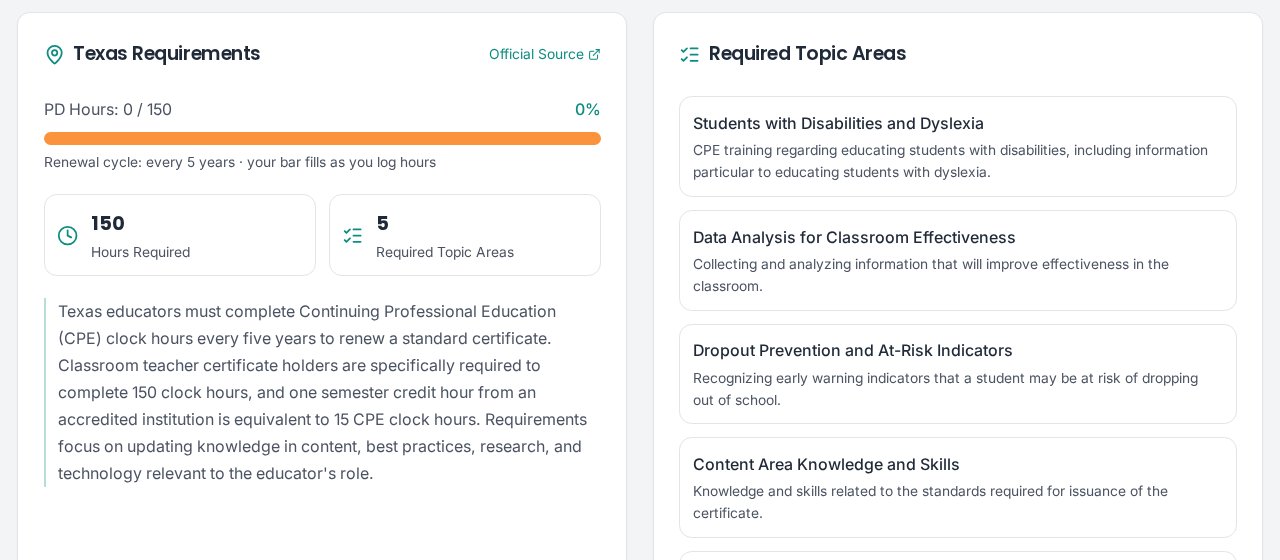
Here is what the Tracker looks like for a Texas teacher: the state hour total, renewal cycle, and every required topic area, pulled from the official source.
What the Tracker does: It opens for your state's actual requirements, not a generic PD counter. Ohio teachers see their CEU total and Ohio's required topics. Texas teachers see the TEA hour count and topic categories. Every state, mapped to what that state's licensing board actually asks for, with the official state source cited directly. Every PD activity you log auto-matches to the topics it covers, and you can manually assign any activity to any topic that fits. Every certificate you earn from a Blueprint course carries a unique verification number (BLC-YYYY-XXXXXXX) your district can look up.
It logs external PD from anywhere. Every workshop, every summer conference, every district in-service day, every course you took from another provider. You add them yourself with the Log Hours button, and they count toward your state total. When it is time to submit for renewal, you export the whole record as a CSV or PDF and hand it to your PD coordinator. Same document works for reimbursement paperwork. The Tracker becomes your single relicensure record, not one more spreadsheet you have to keep updated by hand. And it will honestly show you the topic areas my own courses do not cover, so you know exactly where you still need to look elsewhere.
The Tracker is free, and it will stay free. I also teach professional development courses through Blueprint for Learning Co. My newest is Critical AI Literacy 1: A Professional's Framework, aligned to InTASC and ISTE standards, with a certificate of completion documenting your contact hours. It is designed for K-12 teachers, instructional coaches, and administrators who want a clear framework for judging when AI helps learning, when it gets in the way, and how to explain that difference to parents and colleagues. It is one of many AI PD options on the market. It is the one I would recommend because I built it the way I would have wanted to learn this material myself. Pedagogy-first, practitioner-authored, honest about what AI can and cannot do in a real classroom.
You can find it here: Critical AI Literacy 1: A Professional's Framework. Course 2, AI-Ready Assessment Design, is live too. Courses 3 through 6 are in build across the next 12 to 18 months.
If a full course is not where you are yet, the Professional Judgment Test is a free five-question rubric for evaluating any AI tool before it enters your classroom. It is on my Free Resources page. Use it, share it with your team, and see if the frame matches how you already think.
Whatever you choose, choose something. The months ahead in K-12 AI policy are going to be busier than the ones behind us. Getting ahead of them is easier now than it will be when your renewal window opens.
Blueprint for Learning Co. is founded and taught by a National Board Certified Teacher with an ISTE Certification through Johns Hopkins University, a Master's in Curriculum and Instruction, and 20+ years of K-12 classroom, coaching, and curriculum design experience.
Join the Email List
No fluff, no spam. Just strategies, resources, and updates worth opening.